
Showing posts with label poem. Show all posts
Showing posts with label poem. Show all posts
Sunday, January 21, 2018


Saturday, November 4, 2017
* BALCONIES OF TIME NOW AVAILABLE ONLINE!

To buy it in India visit http://www.hawakal.com/books/english-books/balconies-of-time/
To buy it in the UK visit https://www.amazon.co.uk/dp/8193532538/ref=sr_1_1?s=books&ie=UTF8&qid=1509699824&sr=1-1&keywords=amit+shankar+saha
To buy it in the US visit https://www.amazon.com/dp/8193532538/ref=sr_1_1?ie=UTF8&qid=1509699753&sr=8-1&keywords=amit+shankar+saha
Monday, October 30, 2017
* BALCONIES OF TIME
My debut collection of poems titled BALCONIES OF TIME is published by Hawakal Publishers and is available online at http://www.hawakal.com/books/english-books/balconies-of-time/

Wednesday, July 12, 2017
* Poem at Duane's PoeTree!
Read my poem "Where I Come From" here https://duanespoetree.blogspot.in/2017/07/amit-shankar-saha-writes.html
Wednesday, June 14, 2017
* Publications!
Read my poems "Heartbreak of the Lost Earth", "Coral" and "The One I Should Not Name" published in The Cauldron, 7th Issue, 2017 - http://www.dolchhut.com/2017/06/the-cauldron-7th.html?m=1
Read my conversation with Pragati Gupta on love at Bonobology - https://www.bonobology.com/love/the-paradox-of-love/1037-the-experiences-of-being-in-love-with-many-men-and-women
Read my review of Prof. Sanjukta Dasgupta's fifth collection of poems Lakshmi Unbound at Setu Magazine - http://www.setumag.com/2017/05/lakshmi-unbound-sanjukta-dasgupta.html
Tuesday, April 18, 2017
* Spring 2017!
My research article "Existential
Alienation and the Indian Diaspora: An Approach to the Writings of Anita Desai,
Bharati Mukherjee, Sunetra Gupta, and Jhumpa Lahiri" published in CLRI journal. Visit: http://literaryjournal.in/index.php/clri/article/view/156
My book review of Lopa Banerjee's Thwarted Escape: An Immigrants's
Wayward Journey published in Bonobology blog. Visit: https://www.bonobology.com/blogs/917-amit-shankar-saha/43-my-love-affair-with-lopa-banerjee-a-review-of-thwarted-escape-by-dr-amit-shankar-saha
My poems "The Bermuda Triangle" and
"The Last Riverine Civilization" published in Tuck Magazine. Visit: http://tuckmagazine.com/2017/03/29/poetry-788/
My poem "A Secret of Forests"
published in Oddball Magazine.
Visit: https://oddballmagazine.com/2017/04/12/poem-by-dr-amit-shankar-saha/
My poem "Autism" (#26)
published in Different Truths online anthology on Autism awareness.
Visit: http://www.differenttruths.com/literature/poems/an-anthology-of-poems-on-autism-awareness/
~~~~~~~~~~~~
Report
"Workshop on "Songs, Roots,
Inheritance: Caryapada to Gitagovinda, Samkhya to Sahajiya"
15th April 2017
On the first day of the Bengali New Year a
one-day workshop on “Songs, Roots, Inheritance: Caryapada to Gitagovinda,
Samkhya to Sahajiya” was organized by Shoptodina Foundation at Mahabodhi
Society Hall, Kolkata. The workshop saw three presentations starting
with the playing of a song from the Caryapadas, the oldest existing text of
Bengali literature. The first presentation was by Dr. Tamal Dasgupta who
introduced the theme and said that song is the language that has connected
human beings since ancient times. Perhaps the Neanderthals got extinct in
competition because of the Homo Sapiens’ ability to sing. He went on to
explicate from the 3500-year old Hurrian hymn on how the transformation of
foraging culture to agrarian culture affected human beings. From Krishna’s
flute to Shakti worship at Pandu Rajar Dhipi are all perhaps fertility rituals.
He brought focus on Samkhya philosophy and how its development through stages
of ancient, classical, Sahajiya, Tantric and other forms saw aspects of duality
between Purusha and Prakiti. He also brought in psychoanalysis and logocentrism
to explain the materialistic base and tragic vision of Samkhya. His thrust was
on the concept that Indian civilization is Samkhya-based and not Veda-based. He
then went on to elaborate on how Lakshman Sen’s court poet Jayadeva’s Gitagovinda has Sahajiya philosophy at its
root.

Post lunch-break saw two presentations on
Kirtan and Baul tradition by Sayantan Thakur and AnirbanMondal
respectively.Sayantan Thakur interspersed his presentation with beautiful
rendition of kirtans while expounding on the various types of kirtans like Naamkirtan,
Lila kirtan, Suk kirtan, Gunakirtan, Dhopkirtan, etc. He said that the two
prominent gharanas of kirtans viz. Garenhatigharana and Manoharsaingharana gave
the 162 taals used in kirtan. He said that kirtan has six parts – Katha, Sur,
Taal, Katang, Aakhor, Doha – and how Gitagovinda’staals
are kholtaal and not of pakhwaj. Sayantan Thakur created an atmosphere of
serenity through his excellent singing skills and knowledge of ragas. After him
the presentation on Baul tradition saw AnirbanMondal elucidate on how Baul
originated as an alternative to conventional religion and represented a social
revolution. He said that the etymology of the word “baul” is from “batul” which
means crazy. He made it pertinent that in the Baul tradition the status of woman
was very high and a woman could also be a “guru” and give “diksha” to
disciples. The Baul tradition attracted marginalized people across class,
religion, social and economic backgrounds.


Tuesday, January 31, 2017
* Release of Rhythm Divine Poets Anthology!
Rhythm Divine Poets Anthology Volume 1 (2016) was released by noted Indian poet Sharmila Ray and US poet Neal Hall at Art Rickshaw on 21st January, 2017.

It was followed by a formal book launch at the Kolkata International Book Fair.


Rhythm Divine Poets also did a poetry event at the US pavilion at the Kolkata International Book Fair.


Friday, February 19, 2016
* A Featured Story and a Few Poems!
My story "Love and Hate" is the featured story in Wordweavers Contest 2015. Read it here:
My poem "Silverfish" published in the New Year 2016 Literature Special issue of Learning and Creativity e-zine. Read it here:
My poem "Love in the Time of the Atom Bomb"published in the anthology The Red Balloons: A Journey of Love released on Valentine's Day.

My poem "Create to Inspire" published in The Dawn Beyond Waste Anthology released at ICCR on 9 February, 2016.

Poetry Meet at the residence of Prof. Jharna Sanyal on 14 February, 2016.

Poetry Reading at the Launch of Chandana Khan's book The Shadow Women at Kolkata Book Fair Media Centre on 7 February, 2016:

Saturday, January 30, 2016
* An Award for a Short Story, Some Poems, a Review and a Few Performances!
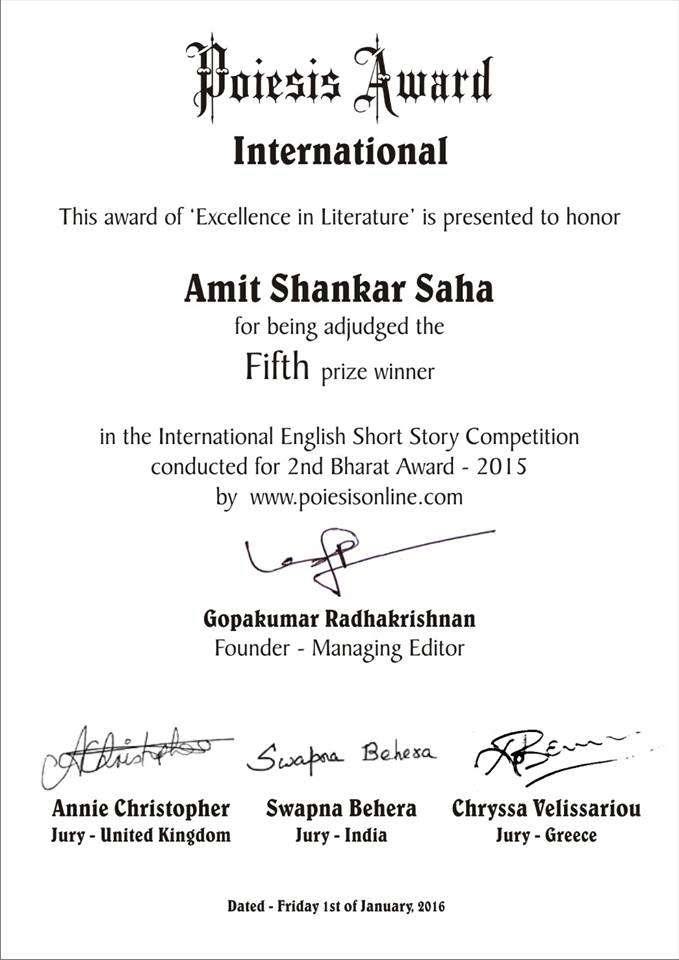
My short story "Harappa" was awarded the fifth prize in the 2nd Bharat Award 2015 short story competition.
Read my poems "Silence" and "Corner" published in the December 2015 issue of Hall of Poets e-zine here:
http://issuu.com/drprernasingla/docs/hop_dec_2015
Read my poem "A Killing", which is the featured poem at the Wordweavers Poetry Competition 2015 here:
http://wordweavers.in/2015_poetry_longlist_amit_shankar_saha.html
Read my poem "A Killing", which is the featured poem at the Wordweavers Poetry Competition 2015 here:
http://wordweavers.in/2015_poetry_longlist_amit_shankar_saha.html
Read my review of Ananya Chatterjee's third collection of poems The Blind Man's Rainbow here:
My performance at Mudra Arts Workshop


My performance at the cover launch of Sutapa Basu's novel Dangle


Wednesday, October 28, 2015
* Poem Shortlisted!
My poem "A Killing" has been shortlisted for Wordweavers Poetry Contest 2015. Visit http://wordweavers.in/2015_poetry_longlist_amit_shankar_saha.html
Wednesday, August 26, 2015
* A Review and a Report!
Read my review of Saikat Majumdar's new novel The Firebird in Being Bookworms - http://beingbookworms.blogspot.in/2015/08/the-firebird-story-that-captured-our.html
Read my report of the discussion on Avik Chanda's latest novel Anchor in Being Bookworms - http://beingbookworms.blogspot.in/2015/08/readers-and-writers-club-initiates-avik.html
Read, vote, rate and comment on my poems at the Delhi Poetry Challenge here - http://www.readomania.com/author/amitss6
Tuesday, September 30, 2014
* Wordweavers Poetry Longlist!
Read my poem "Behind the Curtain" currently longlisted in the Wordweavers Poetry Competition 2014 - http://wordweavers.in/2014_poetry_longlist_amit_shankar_saha.html
Monday, July 28, 2014
* After Bashabi Fraser's Lecture!
After Bashabi Fraser’s Lecture
The lecture’s over, the embers remain:
Echoes of the Ganga remain,
Remain the echoes of the Tay-
An hour freed from the prose of life,
Dedicated to poetry,
In a world of Ukraines and Palestines.
Words fill the rivulets of ideas
While seeking forms to flow into:
The dynamics of arrivals,
And the stasis of absences,
Chaotic and homebound, like boys
Distributing at the mouth of the school,
The mind resounds the words from its replenished store
In tune with Kathak and Holi on Scottish shore.
Echoes of the Ganga remain,
Remain the echoes of the Tay-
An hour freed from the prose of life,
Dedicated to poetry,
In a world of Ukraines and Palestines.
Words fill the rivulets of ideas
While seeking forms to flow into:
The dynamics of arrivals,
And the stasis of absences,
Chaotic and homebound, like boys
Distributing at the mouth of the school,
The mind resounds the words from its replenished store
In tune with Kathak and Holi on Scottish shore.
Thank you Saptarshi Mallick for inviting me to Prof. Bashabi Fraser's lecture at St. Xavier's Hall on 21st July, 2014.
Sunday, March 30, 2014
* Cha: An Asian Literary Journal
My poem "Aphasia" is one of the highly commended poems of "Void" Poetry Contest and is published in Cha: An Asian Literary Journal's Sixth Anniversary Issue (Issue 23, March 2014).
Here is the link to my poem:
Here is the link to my poem:
http://www.asiancha.com/content/view/1705/440/
Also visit the Cha Blog for commentaries on the winning poems:
http://asiancha.blogspot.in/2014/03/cha-void-poetry-contest-winners.html
Also visit the Cha Blog for commentaries on the winning poems:
http://asiancha.blogspot.in/2014/03/cha-void-poetry-contest-winners.html
Tuesday, May 28, 2013
* A Poem
The Swing
I see simmering forms in the void:
Two little boys with their mother -
That evening when the Nor-Westers came
And the raindrops kept splashing on the floor.
The electric bulb curdled the gloomy
Atmosphere that had enveloped the room.
They now approach the door and instantly
Again recede. My heart overcomes
With a sense of deja vu whenever
A room, a swing, a rain, a cloud I see.
Two little boys with their mother -
That evening when the Nor-Westers came
And the raindrops kept splashing on the floor.
The electric bulb curdled the gloomy
Atmosphere that had enveloped the room.
They now approach the door and instantly
Again recede. My heart overcomes
With a sense of deja vu whenever
A room, a swing, a rain, a cloud I see.
Thursday, April 26, 2012
* A Poem
Not Yet Born Then
It is before my birth.
Past the emergency.
The wane of the naxals.
The waxing communists.
Jyoti Basu speaking.
Test matches at Eden.
Gavaskar on the crease.
Dalda - available.
Farex - out of the stock.
Load-shedding is common.
Trunk calls on telephones.
The tram to Khidderpore.
Rickshaws near Esplanade.
Nahoun in New Market.
Mughlai at Anadi's.
Night shows in cinemas.
The radio at home.
Black and white photographs.
My elders are youngsters.
The world before my birth.
Some things have changed since then,
Some things remain the same.
Except my perspective
On things that still remain.
It took aeons to get
The perfect condition
For my birth to take place.
I am now a part of
It is before my birth.
Past the emergency.
The wane of the naxals.
The waxing communists.
Jyoti Basu speaking.
Test matches at Eden.
Gavaskar on the crease.
Dalda - available.
Farex - out of the stock.
Load-shedding is common.
Trunk calls on telephones.
The tram to Khidderpore.
Rickshaws near Esplanade.
Nahoun in New Market.
Mughlai at Anadi's.
Night shows in cinemas.
The radio at home.
Black and white photographs.
My elders are youngsters.
The world before my birth.
Some things have changed since then,
Some things remain the same.
Except my perspective
On things that still remain.
It took aeons to get
The perfect condition
For my birth to take place.
I am now a part of
The aeon that gives birth
To subsequent changes.
Sunday, March 25, 2012
* Convocation of Calcutta University!
The Convocation of Calcutta University took place on 22nd March, 2012, in the Centenary Hall presided by the Chancellor, Shri M. K. Narayanan (Hon’ble Governor of West Bengal). The chief guest was Shri Shyam Benegal. Here are some photographs of the event where I was conferred the doctorate degree by the Vice-Chancellor.
 |
| Being conferred the PhD degree |
 |
| With Dr. Santanu Majumdar and Prof. Sanjukta Dasgupta |
 |
| Dignitaries on the dais |
 |
| The Centenary Hall |


In January my supervisor, Dr. Santanu Majumdar, made a paper presentation at a seminar in Bhubaneshwar. Here is a picture of him in panel discussion at the event.
___________________________________________
My poems "At the Asutosh Museum of Indian Art" and "Not Yet Born Then" have been published in the latest issue of Kritya: Poetry Journal (VOL- VII /
ISSUE -IX, March -2012). Read them here - http://kritya.in/0709/En/poetry_at_our_time.html
Friday, May 20, 2011
* The Day They Brought in Change
[This blog post is especially for Tamal, whose birthday is today.]
It is the month of May and my grandchildren are visiting me during their summer vacation. I had insisted with my sons and daughters that they send their children to me during their summer holidays because I wanted to pass on to them the forgotten art of story-telling. In the indolence of the simmering summer days I have regaled them with myths and legends and they have been enthusiast listeners too. But today I have chosen to tell them a true story - the story of how people brought change in Bengal more than thirty years ago. And how the mighty had fallen against the struggle of a generation and how we should be grateful to those people who brought prosperity that we continue to enjoy today. My grandchildren have a skeptical look on their faces when I say that this all happened in front of my eyes. So to make is sound authentic I tell them the name of Buddhadeb, the mighty chief-minister of who once ruled over Bengal.
The youngest of my listeners, on hearing the name cries out, “Is he related to Aranyadeb - The Phantom whose story you told us one day?” The oldest of the lot, who was old enough to understand history, guffawed loudly to the chagrin of the little one. I remember that last year I had told them the story of The Phantom. But since these kids were growing up watching the urban superheroes in films they could not relate to the forest-dwelling superhero. So I had taken them for a visit to Jungle Mahal to witness the life of the tribal people living close to nature. But now silence has again prevailed and I tell the children that Buddhadeb was not a superhero. I add that he did not live in the forests because the forests at that time were infested with Maoists guerrillas. The chief-minister was a man of hubris and his downfall was brought by the woman under whose leadership change was ushered in. That woman was called Mamata - the champion of the poor.
It was now the turn of the eldest to question me. “But didn’t she have to tackle the Maoists too?” The youngest could not have a revengeful laugh because the topic had already surpassed her comprehension. So I give them a simplified answer, “She gave orders and everything stopped. It was because the people trusted her.” They all sigh an “Oh!” But one of the older ones again asks, “How did she gain the trust of the people?” So I tell them that it all began in what is now the industrial town of Singur and how the then government’s land acquisition policy backfired because it belittled the opposition and used strong-arm tactics against the poor farmers. And Mamata led the agitation promising to return the land of the farmers if she was voted to power. Then again in Nandigram, which is now an agricultural hub, many people who were opposing the land-grabbing attempts of the government were killed by the ruling forces. And again the oppressed farmers found the champion of the poor beside them fighting for their cause.
This time the youngest, again finding courage, asks, “Were those responsible for killing the people punished?” I say, “Yes. In the summer of 2011 the man of hubris was inflicted a crushing defeat at the hands of the champion of the poor in the Assembly election.” The children are satisfied so I do not go on to tell them about the poor condition of the state health services or the problems of the state education system or the general state of lethargy and and corruption in the government or the regimented system of favouritism and victimisation by the ruling party prevalent in the state at that time. These children who are born in one of the leading states of India may not be able to appreciate the struggles of the likes of Kabir Suman and Bratya Basu to bring in the change. But these children when they grow up will tell their progeny the story of the triumph of the champion of the poor over the man of hubris that day long time back even before their parents were born. So I continue with my story of how hopes were fulfilled through the change brought in then.
------------------------------------------------------------------------------------------------

My research article "Emotional and Sexual Wants in Diasporic Life as Depicted by Jhumpa Lahiri" has been published in the book Indo-English Fiction: New Perspectives, Ed. Arvind M. Nawale, Jaipur: Aadi Publishers, 2011, ISBN: 978-93-80902-39-5.
Read my review of Nishi Pulugurtha's Derozio: A Monograph in Muse India Issue 37.
Read my poem "Peace of Mind" at Best-Poems.net.
Friday, April 22, 2011
* The Anthonian's Literary Pursuits


Read my poem "Dream College", which won the First Prize in Poetry at the Wordweavers Contest 2011.

Read my poem "To Florence", published in Issue 11 of Palki.

Read about my experiences in the British Council library (Kolkata) at Indian Blog World.
The article also appears in the official blog of the British Council at http://britishcouncilindia.wordpress.com/2011/04/21/my-journey-with-british-council-library-1996-2011/
 Visit my school's literary club's blog - The Anthonian Literary Club - http://antlit.blogspot.com/
 Wednesday, November 17, 2010
Subscribe to:
Posts (Atom)